Selling on eBay takes four steps: create a free seller account, list an item with photos and a keyword-rich title, choose how you will ship it, and send it within your stated handling time once it sells. Your first listing can be live in under 30 minutes, and eBay gives every new seller 250 free listings per month.
That is the short version. The longer version, the one that decides whether you make consistent money or quit after three sales, involves fees, selling limits, seller metrics, and knowing what to sell in the first place. This guide covers the full path from zero to a working eBay operation in 2026.
Step 1: Create Your eBay Seller Account
Go to ebay.com, click Register, and choose between a personal or business account. Personal works fine for testing the waters and selling household items. Pick a business account if you plan to resell products at volume, dropship, or register under a company name, because eBay reports seller income to the IRS on Form 1099-K once you pass $20,000 and 200 transactions in a year (some states report from $600), and matching the account type to reality saves tax headaches later. The eBay 1099-K guide lists the state thresholds.
You will need:
- A verified email address and phone number
- A bank account for payouts (eBay pays via managed payments, not PayPal)
- Government ID for identity verification in most regions
Verification usually clears within a day. Set up your first shipping, payment, and return business policies right after registering, because every listing you create will reuse them.
If you plan to ship items you own, gather the basics before your first sale: a shipping scale, a tape measure, boxes or poly mailers, and packing tape. Accurate weight and size is what keeps calculated shipping honest.
Step 2: Know the Fees Before You List
eBay's fee structure in 2026 has two main parts for most sellers:
| Fee | Typical Amount | When It Applies |
|---|---|---|
| Insertion fee | Free for first 250 listings/month | Each listing beyond the free allocation costs $0.35 |
| Final value fee | Roughly 13.6% in most categories | Charged on total sale amount including shipping |
| Per-order fee | $0.30 or $0.40 | $0.30 on orders of $10 or less, $0.40 above |
| Promoted Listings | Optional, you set the percentage | Only when an ad leads to a sale |
The final value fee percentage varies by category: sneakers, guitars, and heavy equipment have different rates. Check your exact numbers with our free eBay fee calculator before you price anything, and read the full fee breakdown so nothing surprises you at payout time.
A working rule for resellers: your sale price needs to cover product cost, shipping, roughly 14% in fees, and still leave your target margin. Price backwards from that.
Step 3: Decide What to Sell
Beginners have three realistic sourcing paths:
Sell what you own. Zero risk, and it builds your feedback score. Electronics, branded clothing, and collectibles move fastest.
Retail arbitrage. Buy discounted products locally or online, resell at market price. Low startup cost, hard to scale.
Dropshipping. List products from a wholesale supplier, and the supplier ships after you sell. No inventory investment, but eBay's dropshipping policy only allows fulfillment from wholesale suppliers, not from other retail marketplaces. Understand the rules before choosing this path.
Whatever the path, research demand before listing. eBay's Terapeak tool (free in Seller Hub) shows real sold prices and sell-through rates. Data-driven sellers also use a product finder that surfaces items already selling well for other eBay sellers, which beats guessing.
Step 4: Create a Listing That Sells
eBay listings live or die on three elements:
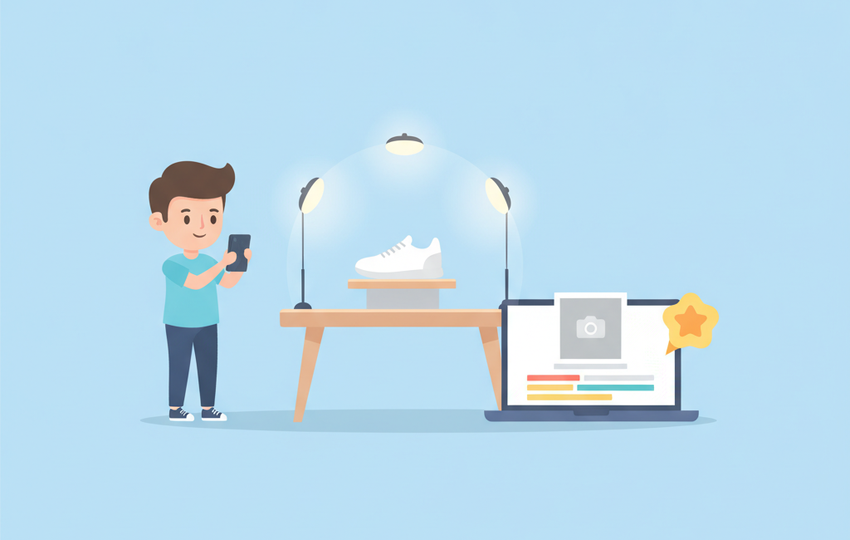
Title. You get 80 characters. Use them for keywords buyers actually type: brand, model, size, color, condition. "Nike Air Max 90 Mens 11 White Running Shoes New" beats "Amazing shoes must see!!" every time. A title builder generates keyword-optimized titles from live eBay search data if you do not want to guess.
Photos. Up to 24 free photos, use at least 6. Natural light, plain background, every angle, every flaw. eBay requires photos of at least 500 pixels on the longest side, and listings with better photos win the Best Match algorithm's click-through signal.
Item specifics. These structured fields (brand, size, material, MPN) feed eBay search filters and Google Shopping. Fill every required and recommended field. Listings missing item specifics are invisible to buyers who filter search results, which is most buyers.
Set a competitive price by checking sold listings, not active ones. Active listings show what sellers wish items were worth. Sold listings show reality.
For your first sales, start with Buy It Now fixed-price listings and Good Til Cancelled duration. Auctions only outperform for rare or high-demand items.
Step 5: Ship Fast and Communicate
When an item sells:
- Ship within your stated handling time (1 business day is the standard buyers expect)
- Upload tracking immediately, eBay validates carrier scans against your promise
- Answer buyer messages within 24 hours
Late shipments and missing tracking damage your seller level, which controls your search visibility and fee rate. New sellers should read how shipping times affect your account before their first sale, not after their first defect.
How Much Does eBay Take From a $100 Sale?
eBay takes about $14 from a $100 sale in most categories: a 13.6% final value fee ($13.60) plus the $0.40 per-order fee, leaving you $86 before your item and shipping costs. The fee applies to the total the buyer pays, so if the buyer also pays $10 shipping, eBay takes 13.6% of $110.
| Sale total | eBay fee (most categories, no store) | You keep before costs |
|---|---|---|
| $20 | $3.12 | $16.88 |
| $50 | $7.20 | $42.80 |
| $100 | $14.00 | $86.00 |
| $500 | $68.40 | $431.60 |
Run your own numbers, including store discounts and promoted listings, in the eBay fee calculator.
How Much Does It Cost to Start Selling on eBay?
Starting to sell on eBay costs nothing up front: registering is free and every seller gets 250 free listings a month. You pay only when an item sells, through the final value fee and per-order fee, plus optional costs like promoted listings or an eBay Store subscription once you outgrow the free listings.
Who Pays for Shipping on eBay?
The seller decides who pays for shipping on eBay. You can charge the buyer a flat or calculated shipping cost, or offer free shipping and build the cost into your price. Free shipping usually ranks and converts better, and eBay charges its final value fee on shipping either way, so the total cost to you is similar.
The Limits and Risks Nobody Mentions
Selling limits. New accounts start capped, typically 10 items or $500 per month. eBay raises limits as you sell and deliver reliably, and you can request increases monthly. Full details in our selling limits guide.
Payout holds. eBay holds funds from new sellers for up to 30 days until you build delivery history. Do not spend money you have not received.
Metric penalties. eBay tracks your defect rate, late shipment rate, and cases closed without resolution. Fall below standard and your visibility drops while your fees rise. The thresholds and recovery process are covered in our seller levels guide.
Account suspension. Selling prohibited items, listing trademarked products carelessly, or racking up policy violations can end an account quickly. Check brands against a VeRO checker before listing anything branded, and review the suspension prevention guide once your store grows.
What Is the Downside of Selling on eBay?
The main downsides of selling on eBay are fees of around 14% per sale, low selling limits for new accounts, payout holds of up to 30 days, and strict seller metrics that cut your visibility if you ship late. You also cannot collect buyer emails or build a brand the way you can on your own store.
How to Scale Past Your First Sales
Manual listing works for 10 items. It collapses at 100. Sellers who scale follow the same pattern:
- Reinvest early profits into more inventory or better sourcing
- Systematize listing. Templates, saved business policies, and bulk tools cut listing time from 15 minutes to under 2. A 1-click lister imports a supplier product with photos, variants, and specifics filled automatically.
- Automate monitoring. Price changes and stockouts at your source are the top cause of defects for resellers. Price and stock monitoring flags supplier price and stock changes so you can reprice or end listings before a buyer orders something you cannot deliver.
- Request limit increases monthly and grow listings steadily. Sudden listing spikes trigger account reviews.
- Track profit per order, not revenue. Fees, shipping, and returns eat 20 to 35% of gross.
Your First 30 Days: Checklist
- Register and verify your seller account
- Set up one shipping, payment, and return business policy
- List 5 to 10 items you own, with 6+ photos each
- Price from sold listings, not active ones
- Ship every order within 1 business day with tracking
- Answer every message within 24 hours
- After week two, request your first selling limit increase
- Review your Seller Hub traffic report and improve your weakest title
Selling on eBay in 2026 rewards the same things it always has: honest listings, fast shipping, and consistent volume. The difference now is how much of the busywork you can automate. When you are ready to move from selling a few items to running a store, SuperDS handles listing, repricing, and order sync so you can spend your time on sourcing. Start free and see how fast listing can be.