
An eBay 1099-K is the IRS form eBay sends to sellers (and to the IRS) showing the gross amount of payments processed through your account in a calendar year. For tax year 2025 and 2026, the federal threshold is more than $20,000 in gross payments and more than 200 transactions, restored by the One Big Beautiful Bill Act signed in July 2025. Several states require the form at $600, and whether or not you receive one, eBay income is taxable.
I run dropshipping accounts that cross the threshold every year, and the form itself is the easy part. The hard part is that the number on it is gross, it includes refunds and shipping, and it looks nothing like the profit you actually made. This guide covers the current thresholds (federal and state), what eBay reports, how to reconcile gross to net as a dropshipper, Schedule C basics, sales tax, a note for UK sellers, and the mistakes that trigger IRS letters. This is general information, not tax advice; talk to a tax professional about your situation.
What is the eBay 1099 threshold for 2025 and 2026?
The federal rule swung twice in five years. The American Rescue Plan Act of 2021 tried to lower the reporting threshold to $600 with no transaction minimum. The IRS delayed it three times, then the One Big Beautiful Bill Act (signed July 4, 2025) repealed it and reinstated the original test. The IRS's own FAQ states that third-party settlement organizations must file a 1099-K only when gross payments to a payee exceed $20,000 and the number of transactions exceeds 200. Both conditions must be met. For when and how eBay pays you out, see our guide to eBay payouts and holds.
eBay's Form 1099-K help page confirms it applies the same test, and adds two details that matter for dropshippers:
- Multiple accounts are combined - if you have several eBay accounts under the same Tax ID, eBay adds up the payments and transactions across all of them to test the threshold. Running three accounts at $8,000 each does not keep you under $20,000. Our multi-account guide covers the compliance side of that setup.
- The form arrives by January 31 - electronically in Seller Hub under Payments, and by mail if you did not opt into electronic delivery.
Which states have a lower 1099-K threshold than the IRS?
The federal rollback did not change state law. Payment processors including eBay must still file with these states at their own thresholds, and you will receive a copy. As of September 2026, the commonly cited state thresholds are:
| State | 1099-K threshold | Transaction minimum |
|---|---|---|
| Massachusetts | $600 | None |
| Vermont | $600 | None |
| Virginia | $600 | None |
| Maryland | $600 | None |
| District of Columbia | $600 | None |
| Montana | $600 | None |
| North Carolina | $600 | None |
| Illinois | $1,000 | 4 or more transactions |
| New Jersey | $1,000 | None |
| Missouri | $1,200 | None |
| All other states | Federal: $20,000 | Federal: 200 |
State legislatures change these, and a few states copy whatever the federal number is at the time, so check your state's department of revenue page before filing. The point is not the exact dollar figure. It is that a Massachusetts seller who did $4,000 on eBay will get a 1099-K, and the IRS gets a copy too.
Does eBay report to the IRS, and what exactly does it report?
Yes. When the threshold is met, eBay files the 1099-K with the IRS and, where required, with your state. The form reports gross payments. eBay's help page says the amount "does not include any adjustments, for example, credits, discounts, fees, refunds, or any other adjustable amounts". In practice, for a US eBay seller, the gross figure:
- Includes the item price the buyer paid.
- Includes shipping the buyer paid you.
- Includes orders you later refunded in full or in part.
- Excludes sales tax that eBay collected and remitted as a marketplace facilitator. eBay's page specifically lists sales tax and canceled transactions as excluded.
- Excludes nothing else. eBay's final value fees, promoted listing fees, shipping labels you bought and your supplier costs are all still inside the gross number.
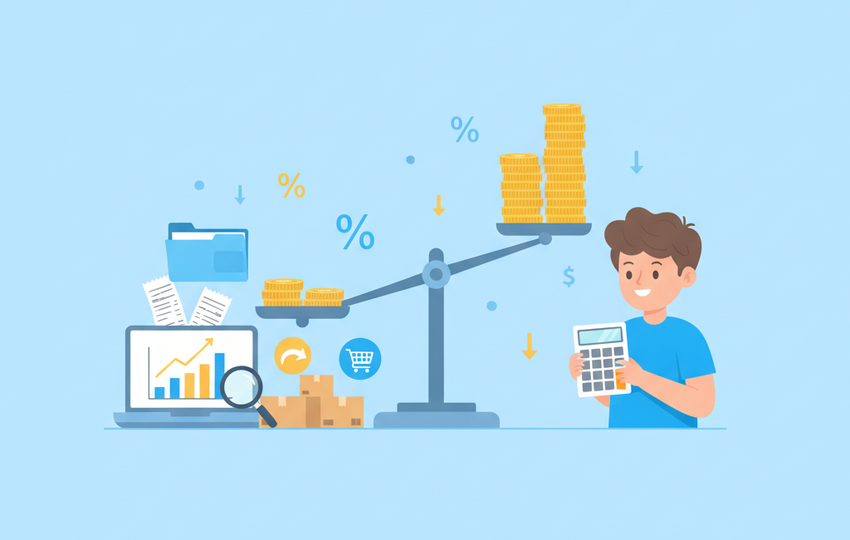
So a dropshipper who sold $60,000 worth of goods, refunded $2,400, paid $8,600 in eBay fees and $38,000 to suppliers will see roughly $60,000 on Box 1a. Their actual profit before other expenses is closer to $11,000. If they report the $60,000 as income with no deductions, they pay tax on money they never kept.
How do dropshippers reconcile the 1099-K gross to real profit?
This is the core of eBay taxes for sellers who dropship. Work down from gross in this order.
| Line | Where it comes from | Example |
|---|---|---|
| Gross receipts (1099-K Box 1a) | eBay 1099-K | $60,000 |
| Minus refunds and returns | Seller Hub Payments report, refunds column | $2,400 |
| Equals net sales | $57,600 | |
| Minus cost of goods sold | Supplier order history (Amazon, AliExpress, Walmart, etc.) | $38,000 |
| Equals gross profit | $19,600 | |
| Minus eBay final value and per-order fees | Seller Hub fees report | $7,900 |
| Minus Promoted Listings fees | Seller Hub advertising report | $700 |
| Minus shipping labels you bought | eBay label history or carrier account | $0 (supplier ships) |
| Minus software, subscriptions, home office share, etc. | Your records | $1,400 |
| Equals net profit (Schedule C line 31) | $9,600 |
Two things trip dropshippers specifically:
Cost of goods sold is scattered. Your supplier costs sit in an Amazon order history, an AliExpress account, maybe Walmart and Temu too. If you cannot match each eBay order to the supplier order that fulfilled it, you cannot prove COGS in an audit. Export supplier order histories every month, not in April.
Timing. COGS is deducted in the year the item sold. For dropshipping that is usually the same day, but December orders that the supplier bills in January need to land in the right year.
The Seller Hub Payments tab has a "Reports" section where you can download a full transaction report for the year, with sales, fees, refunds and shipping labels broken out. Download it in January before anything changes.
How do you report eBay income on Schedule C?
If you buy items to resell for profit, the IRS treats you as a business, and business income goes on Schedule C (Form 1040). The basics:
- Line 1, gross receipts - enter the gross from your 1099-K plus any eBay income under the threshold that was not reported. The IRS matches Box 1a against your return, so report at least that number here and deduct below it, rather than reporting a smaller net figure.
- Line 2, returns and allowances - refunds.
- Part III, cost of goods sold - supplier costs including their shipping.
- Part II, expenses - eBay fees, advertising, software, shipping supplies, home office, a share of your phone and internet.
- Self-employment tax - net profit over $400 also owes 15.3% self-employment tax on Schedule SE, on top of income tax. Budget for it with quarterly estimated payments if you expect to owe $1,000 or more for the year.
Hobby versus business. If the IRS decides your selling is a hobby (no profit motive, irregular, no records), you report the income but since 2018 you cannot deduct hobby expenses. For a dropshipper that is a disaster: tax on gross. Keep records, keep a separate bank account, and operate like a business so you are treated like one.
For the broader picture across platforms and countries, see our dropshipping tax guide.
Does eBay collect sales tax for me?
Yes, in every US state with a sales tax. Under marketplace facilitator laws, eBay calculates, collects and remits sales tax on orders shipped to those states. You do not register, collect or file sales tax on eBay sales, and as noted above, that tax is excluded from your 1099-K gross.
Two things you still own:
- Use tax on supplier purchases - if your supplier charged you sales tax, that is part of your COGS. If they did not (some overseas suppliers), some states technically expect use tax. Most small sellers never encounter this, but it is worth a question to your accountant.
- Shopify or your own store - marketplace facilitator rules cover eBay, not your own website. If you also sell on Shopify, you may have sales tax obligations there.
What about UK sellers and HMRC?
The UK has no 1099-K, but since January 2024 eBay UK has been required to report seller data to HMRC under the digital platform reporting rules. eBay reports sellers who complete 30 or more sales in a calendar year or whose sales reach about €2,000 (roughly £1,700). The report goes in by January 31 for the previous year.
Reporting is not the same as owing tax. You get a £1,000 trading allowance per tax year; if your gross trading income is over that, you need to register for Self Assessment and report it. A dropshipper is trading by definition, so plan on Self Assessment from your first year and keep the same gross-to-net records described above, just with eBay UK's fee structure (final value fee, £0.30 per order, 0.35% regulatory operating fee, all plus VAT).
What goes wrong with eBay 1099-K reporting?
- Ignoring the form - the IRS receives a copy. If Box 1a does not appear on your return, the automated underreporter system sends a CP2000 notice proposing tax on the full gross amount plus penalties and interest. Sellers who did $30,000 gross and $5,000 profit get a letter asking for tax on $30,000.
- Reporting net instead of gross - entering $9,600 profit as gross receipts when eBay reported $60,000 creates a mismatch and the same CP2000 letter. Report gross, deduct on the return.
- Missing income under the threshold - no form does not mean no tax. Income is taxable from the first dollar. State sellers with $600 forms learn this quickly; everyone else should behave as if they got one.
- Hobby classification - no records, no separate account, sporadic activity. The IRS can deny every deduction.
- Multiple accounts under one TIN - sellers who split accounts to stay under limits still get one combined 1099-K, and a second account under a family member's SSN moves the tax bill to them along with any eBay policy risk for account linking.
- Not matching supplier orders to sales - the audit question is "prove this $38,000 COGS". Without order-to-order records, the deduction is at risk.
- Personal items mixed in - selling your old laptop on the same account is usually not taxable (sold at a loss), but it inflates your gross. Track it separately so you can back it out with a note.
How do you keep eBay tax records clean all year?
The seller who has a bad April is the seller who tried to rebuild a year of orders from memory. The fix is to record the supplier cost at the moment the order happens.
Sync every order with its supplier cost. SuperDS order sync pulls each eBay order into one dashboard alongside the supplier order that fulfilled it, with the supplier price, eBay sale price and fees on the same row. That is the COGS record the IRS wants, built automatically instead of reconstructed from six supplier accounts.
Watch profit, not revenue. The advanced dashboard shows net profit after fees per order and per month, so the number you are managing during the year is the number you will actually be taxed on. Sellers who track revenue only are surprised twice: once at eBay fees, once at tax.
Download the yearly report in January. Seller Hub, Payments, Reports, full year. Save it with your supplier exports.
Set aside tax from every payout. A simple rule: move 25% to 30% of net profit into a separate account each month. Adjust with your accountant once you know your bracket.
Pay quarterly if you will owe $1,000 or more. Estimated payments are due in April, June, September and January. Missing them adds an underpayment penalty on top of the tax.
Use one account structure you can explain. Multiple accounts are fine when done properly (registered business, one TIN, eBay aware). Multiple accounts under other people's names are a tax and policy problem at once.
eBay 1099-K checklist
- Know your thresholds: federal $20,000 and 200 transactions; $600 in MA, VT, VA, MD, DC, MT, NC; $1,000 in NJ and IL; check your state.
- Report all eBay income whether or not a form arrives.
- Enter the 1099-K gross on Schedule C line 1, then deduct refunds, COGS and fees below it.
- Export supplier order histories monthly and match them to eBay orders.
- Download the Seller Hub full-year transaction report in January.
- Remember eBay's gross excludes sales tax but includes shipping and refunded orders.
- Keep a separate business bank account and records so you are a business, not a hobby.
- Combine multiple accounts under one TIN and expect one combined form.
- Budget 15.3% self-employment tax on net profit and make quarterly payments.
- UK sellers: expect HMRC reporting at 30 sales or about £1,700, and register for Self Assessment above the £1,000 trading allowance.
Get the records right during the year and the eBay 1099-K becomes a number you already know, not a number you have to explain. If your orders are not yet syncing with supplier costs, set up SuperDS before Q4 volume makes the gap bigger.