Are your listings changing behind your back?
Many sellers discover AutoDS sync errors only after a "ghost" price change, a stock-out error, or repeated listing revisions trigger an eBay flag. In 2026, the way you automate matters just as much as what you sell. Understanding the risks of unmonitored AutoDS sync errors is the first step toward protecting your account stability.
If you are looking for a more stable, controlled way to scale, read our full guide here:
Best AutoDS Alternatives for Safer eBay Selling in 2026
What Are AutoDS Sync Errors?
AutoDS sync errors refer to unintended listing changes caused by aggressive, background API updates. While automation is marketed as a "set and forget" solution, the reality is that API-driven changes can happen faster than a seller can verify them.
How API Sync Creates Risks
AutoDS connects to eBay using API integrations. These APIs allow the software to revise your live listings programmatically. You can see how these technical connections work in the official documentation:
eBay Developer API Documentation
The problem arises when supplier prices or stock levels fluctuate multiple times a day. The system pushes these "micro-updates" to eBay instantly. While efficient, this creates a high-frequency activity trail that often signals "unstable automation" to eBay’s monitoring algorithms.
Where Sync Errors Strike
Common AutoDS sync errors include:
- Price "Ghosting": Supplier price jumps, but the API fails to sync correctly, leaving you selling at a loss.
- Rapid-Fire Revisions: A single item being revised 5+ times in 24 hours due to supplier jitter.
- Overridden Custom Data: Your optimized titles or descriptions are "synced" back to generic supplier data.
- Inventory Lag: The tool shows "In Stock," but the sync failed, leading to an Out-of-Stock strike.
Why Sellers Discover Them Too Late
Because these updates happen in the background, you often don't see the error until it hits your bottom line. Usually, problems are caught only after:
- A customer buys an item at an outdated, lower price.
- You receive an "Excessive Revision" warning from eBay.
- Your listing rank drops due to constant, unoptimized background "noise."
This is why many experienced sellers are moving toward more safer eBay selling tools.
How Auto-Sync Increases Listing Activity
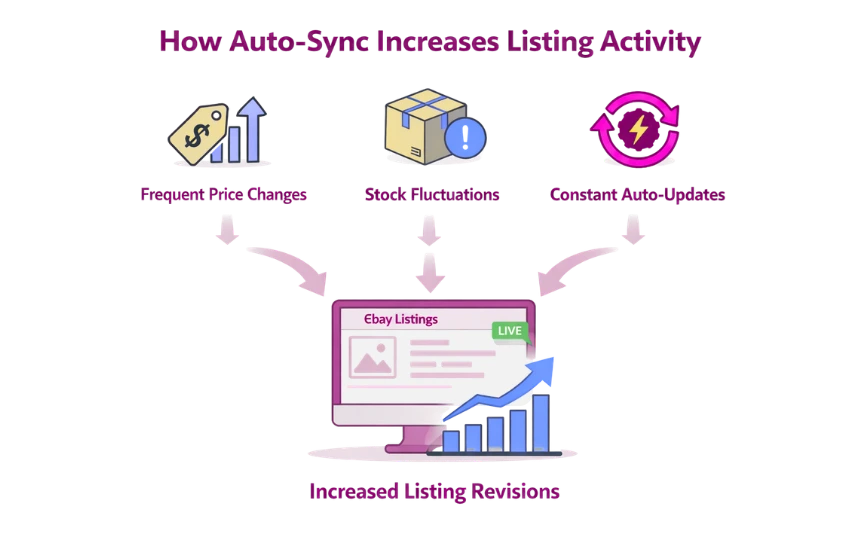
AutoDS sync errors are directly linked to revision frequency. In the eyes of eBay, a store that revises listings hundreds of times a day via API looks different than a store managed with intent.
Frequent Supplier Price Fluctuations
If a supplier adjusts a price by $0.01 multiple times, AutoDS may trigger a full listing revision for every cent. This creates unnecessary background noise on your account.
The "Ping" Effect
Every time an API tool "pings" eBay to update stock, it leaves a footprint. High-volume stores using full automation are often the first to be audited when eBay changes its policy on automation.
For a deeper breakdown of how to avoid these "bot" signals, read:
AutoDS vs Non-API Listing Tools for eBay
Comparison: AutoDS Sync vs. Controlled Workflow
The following table highlights why sellers are choosing controlled alternatives to avoid AutoDS sync errors.
| Scenario | AutoDS API Sync Risk | SuperDS Controlled Workflow |
|---|---|---|
| Supplier price changes 3x/day | 3 Automatic, unverified revisions | No change until you approve the update |
| Supplier goes out of stock | System updates instantly (Risk of sync lag) | Seller verifies and pauses listing manually |
| Importing 50 new items | Go live immediately with API "noise" | Items stay in drafts for SEO optimization |
| Optimized Title/Description | Risk of being overwritten by "Auto-Sync" | Your custom data is locked and protected |
This comparison shows the difference between "Chaos Automation" and "Human-in-the-Loop" scaling.
Why Professional Sellers Are Leaving AutoDS
AutoDS sync errors are more than just a nuisance; they are a threat to your business model.
1. Loss of Manual Oversight
When you lose the ability to "gatekeep" what goes live on your store, you lose control over your brand.
2. Repeated "Bot-Like" Activity
Frequent, automated changes create a pattern of behavior that eBay’s systems can flag. Sellers who value long-term account health prefer tools that batch updates intentionally.
3. Price Mismatches
The "sync" isn't always instant. That 5-minute delay between a supplier price hike and an AutoDS sync can cost you your entire profit margin on a high-ticket item.
To see how we stack up against the competition, check out:
The Best Dropshipping Tool AutoDS vs SuperDS
How to Eliminate Risks from Sync Behavior
You don't have to sacrifice speed for safety. You can reduce AutoDS sync errors by moving to a "Review-Before-Publish" model.
Use a "Draft-First" Approach
Instead of letting an API push products live, use a tool that imports items into a staging area. This allows you to fix errors before eBay sees them.
See our Bulk Import guide
Batch Your Updates
Instead of 100 micro-updates, perform one intentional batch update per day. This mimics natural seller behavior and keeps your account "under the radar."
Learn more about our Bulk Lister feature
Final Thoughts: Stability Over Speed
AutoDS sync errors are a symptom of "over-automation." While it feels faster, the risk of "Silent Sync" errors and account flagging is a high price to pay.
By choosing a controlled, intentional workflow, you protect your eBay store’s reputation and your profit margins. Account stability and disciplined scaling should always be your priority.