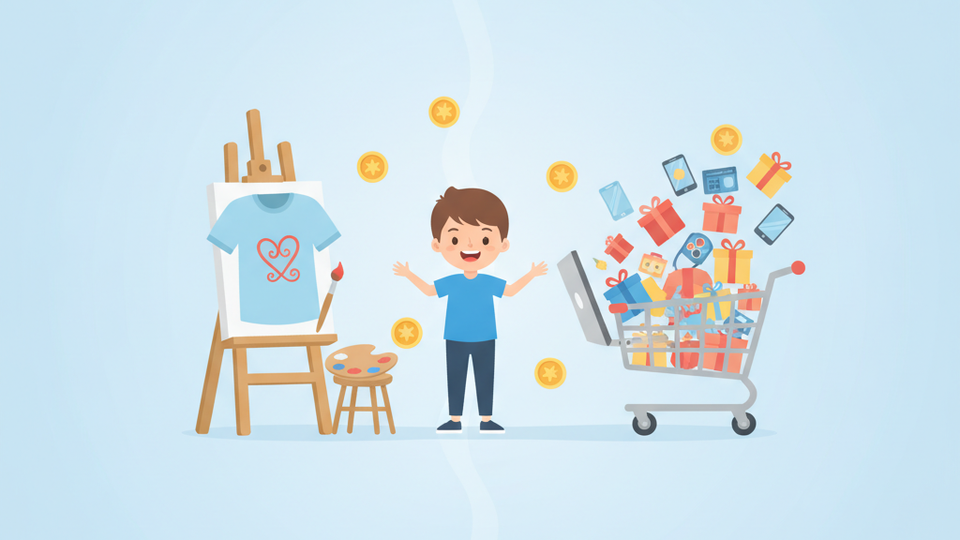
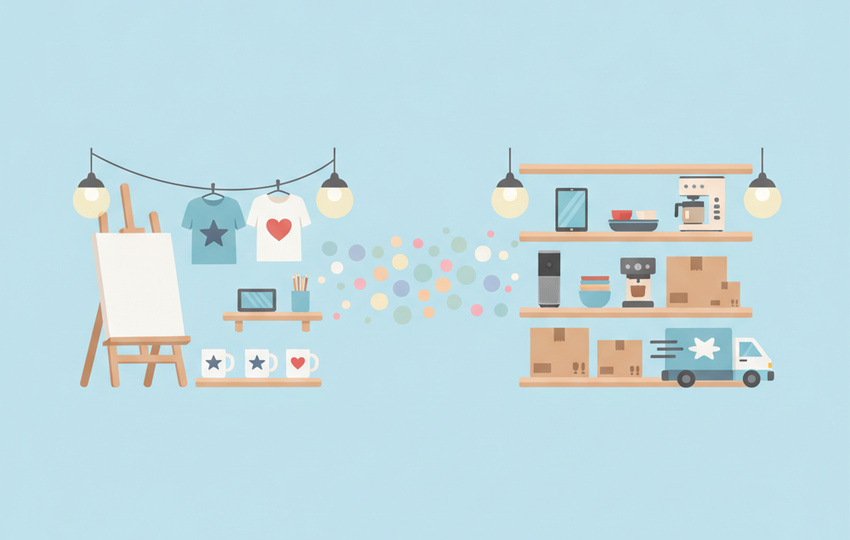
Print on demand (POD) and dropshipping share the same superpower: you sell products you never touch, and pay for inventory only after a customer pays you. The difference is what you sell. POD sells your designs printed on blank goods; dropshipping sells existing products you source from suppliers.
That one difference splits everything downstream: margins, creative workload, shipping speed, and what failure costs. Here is the honest 2026 comparison.
The Models Side by Side
| Factor | Print on Demand | Dropshipping |
|---|---|---|
| What you sell | Your designs on blanks | Existing proven products |
| Startup cost | Near zero | Near zero |
| Per-unit margin | 15-30% at market prices | 10-25%, improvable with sourcing |
| Creative workload | Continuous design production | Product research instead |
| Fulfillment | Provider prints and ships | Supplier ships |
| Delivery speed | 5-10 days (US providers) | 2-30 days depending on supplier |
| Differentiation | Built in, your designs | Low, competitors sell the same item |
| Main account risk | IP takedowns on designs | Supplier reliability, stock sync |
| Winner-take-most factor | Design and niche taste | Speed and operational discipline |
Where POD Wins
Differentiation is structural. Nobody else sells your design. Dropshipping competes on price and delivery for identical items; POD competes on taste, which does not race to the bottom.
Brand equity accumulates. A POD store with a coherent niche identity becomes a brand with repeat buyers. That is harder when your catalog is the same gadgets everyone sources.
Zero supplier hunting. Printful, Printify, Gelato and similar providers are the supplier. No vetting cycles, no stock surprises on blanks, integrated tracking.
Where Dropshipping Wins
Demand is pre-validated. You sell items with visible sales history. Tools like Products Finder show you what already moves on eBay before you list. POD asks you to create demand for designs nobody searched for yet.
Margins respond to effort. Found a winner? Negotiate bulk pricing, switch suppliers, or move to a US warehouse for speed. POD base costs are fixed by the provider, so your only margin lever is charging more.
Catalog velocity. Listing 50 dropshipping products takes an afternoon with a bulk lister. Producing 50 quality designs takes weeks, and most will not sell.
Faster possible delivery. With US suppliers, dropshipping delivers in 2-5 days. POD physically cannot skip production time.
The Risks Each Model Hides
POD's trap is intellectual property. Fan art, sports team references, brand parodies, and celebrity imagery feel like easy sellers and are exactly what triggers VeRO takedowns and account strikes. Marketplaces enforce IP mechanically and repeat strikes end accounts. Original designs only, and screen ideas against a VeRO checker mindset before uploading.
POD's second trap is invisible demand. Nothing tells you a design will not sell until you have spent the time making it. Sellers burn months producing catalogs nobody wanted. Validate niches by studying what sells (bestseller lists, sold listings) before designing.
Dropshipping's trap is operational. Your metrics depend on suppliers you do not control. Stock-outs, silent price hikes, and slow dispatch turn into defects and cases. The cure is automation: price and stock monitoring and order sync close the gap between supplier reality and listing promises.
Both models share the delivery promise problem. Marketplaces hold you to the estimated delivery your settings generate. POD production days and supplier dispatch days both must live inside your handling time, or item not received cases follow. Our INR guide covers what happens when they do not.
A Simple Test to Choose
Answer honestly:
- Do you enjoy making designs, or does it sound like homework? Homework: dropshipping. Genuine yes: POD is viable.
- Do you have a niche or audience you understand deeply? POD thrives on niche taste. Without one, dropshipping's data-driven selection is safer.
- How fast do you want feedback? Dropshipping tells you in days whether a product works. POD feedback loops run weeks per design batch.
- What is your edge: taste or execution? Taste points to POD. Discipline and speed point to dropshipping.
For most sellers starting in 2026, dropshipping is the better first model because the market tells you what to sell instead of asking you to guess. POD becomes powerful later, layered on top as a brand play once you know your niche. The hybrid store (proven dropship products for cash flow, original POD designs for identity and margin) is the strongest end state, and both halves share the same listing and order tooling.
Getting Started Checklist
- Pick your first model with the four-question test above
- Dropshipping: validate 10-20 products against sold data before listing
- POD: pick one niche, produce 10 original designs, zero IP references
- Set handling time to cover real production or dispatch windows
- Automate price, stock, and tracking from the first listing
- Review weekly: kill what does not sell, double down on what does
Both models reward the same underlying skill: listening to demand data faster than competitors do. SuperDS handles the operational half (importing, monitoring, syncing) so your attention stays on the part that compounds.