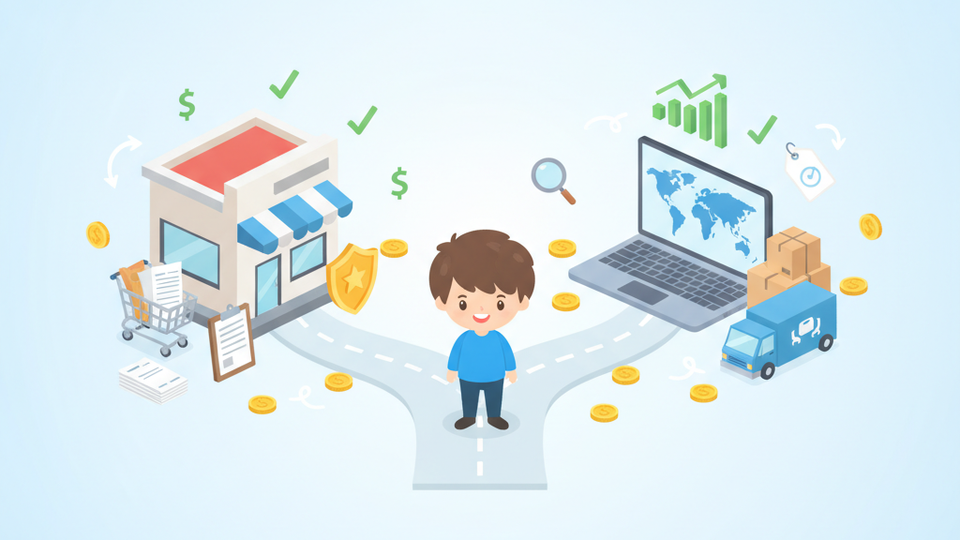
Amazon dropshipping means one of two very different businesses: selling on Amazon while a supplier ships the order for you, or sourcing products from Amazon to sell on another marketplace, usually eBay. Amazon allows the first model only if you are the seller of record on every packing slip and invoice, and it bans buying from another retailer to ship to your Amazon customer. The second model, Amazon to eBay, is where most home-based dropshippers actually operate, and it lives in a grey zone of eBay's Dropshipping Policy that you need to understand before you list your first item.
What does amazon dropshipping actually mean?
Search "amazon dropshipping" and half the results are about model A and half about model B. Sellers mix them up constantly, then apply the wrong policy to the wrong platform.
- Model A: selling on Amazon via dropshipping - you hold an Amazon seller account, list products, and a wholesaler or manufacturer ships each order directly to the buyer under your name.
- Model B: dropshipping from Amazon - you list on eBay (or Shopify, Facebook Marketplace), and when an order comes in you buy the item on Amazon and enter the buyer's address at checkout. Amazon ships it, often with Prime.
Both share the same appeal: no inventory. Everything else, fees, approval, account risk, margins, tools, is different.
Is amazon dropshipping allowed? The Amazon Drop Shipping Policy explained
Amazon's Drop Shipping Policy, published in Seller Central, allows dropshipping on the condition that you are "the seller of record" and the only entity identified as the seller on packing slips, invoices, external packaging and anything else that ships with the product. The policy states that purchasing products from another online retailer and having that retailer ship directly to customers is not allowed if the shipment identifies anyone other than you.
In plain seller terms:
- Allowed - a wholesaler, brand or 3PL ships your Amazon orders in plain packaging with your business name on the slip, and you have a written agreement that they act on your behalf.
- Not allowed - buying the item from Walmart, Target, Home Depot, eBay or AliExpress and shipping it to your Amazon buyer. That is retail arbitrage by mail, and Amazon deactivates for it under "Section 3" of the Business Solutions Agreement, the clause covering policy violations.
Amazon also states that violations "negatively impact your account health and your ability to fulfil future orders using Merchant Fulfilled Network." In practice that means a deactivation email, a request for wholesale invoices you do not have, and weeks of appeals. The seller forums are full of "deactivated for Walmart dropshipping" threads from 2025 and 2026, and reinstatement rates are low because retail receipts are not accepted as proof of sourcing.
What model A costs
You need the Professional selling plan at $39.99 a month (the Individual plan charges $0.99 per item and locks you out of most features). Referral fees run 8 to 15 percent in most categories, with 15 percent the most common. Media categories add a $1.80 closing fee per unit. Then you pay the supplier and the supplier's shipping, and you need real wholesale invoices on file for the day Amazon asks.
How to dropship from Amazon to eBay (model B)
This is the version most eBay dropshippers run, and the one SuperDS is built around. The workflow:
- Find a product on Amazon that sells on eBay at a higher price.
- List it on eBay with your own title, photos and item specifics.
- When it sells, buy it on Amazon with the eBay buyer's address, gift option unticked.
- Paste the tracking number into eBay.
- Handle any returns or questions yourself.
The math on a typical item: a $28 Amazon kitchen gadget listed at $44.99 on eBay with free shipping. eBay's final value fee is 13.6 percent of the total plus $0.40 per order in most categories, so $6.52 in fees. Net is $44.99 minus $6.52 minus $28 equals $10.47, about 23 percent margin, before returns and Amazon price changes.
Before you list an Amazon product on eBay, check that it actually sells and that its price is stable. The AMZScout MCP connector lets Claude or ChatGPT pull live Amazon data on a product, such as price, sales and competition, so you can compare candidates before you source them.
What eBay's Dropshipping Policy says about it
eBay's "Dropshipping and product sourcing" help page states that dropshipping, "where you fulfil orders directly from a wholesale supplier, is allowed on eBay," and in the next sentence that "listing an item on eBay and then purchasing the item from another retailer or marketplace that ships directly to your customer is not allowed."
So model B is against the letter of the policy. Here is what that means in practice as of September 2026:
- eBay does not scan your Amazon account. Enforcement happens when buyers complain: an Amazon box shows up, a gift receipt shows a lower price, or a package is late and an Item Not Received case opens.
- The usual consequence is not an instant ban. It is a listing removal, then a selling restriction, then, for repeat cases, suspension under the Seller Performance Standards for defect rate and late shipment.
- Sellers with low defect rates, fast tracking uploads and quick refunds run this model for years. Sellers who ignore cases lose accounts in months.
Read the full policy page on eBay's Seller Center before you decide, and reread it every few months. The wording has shifted before.
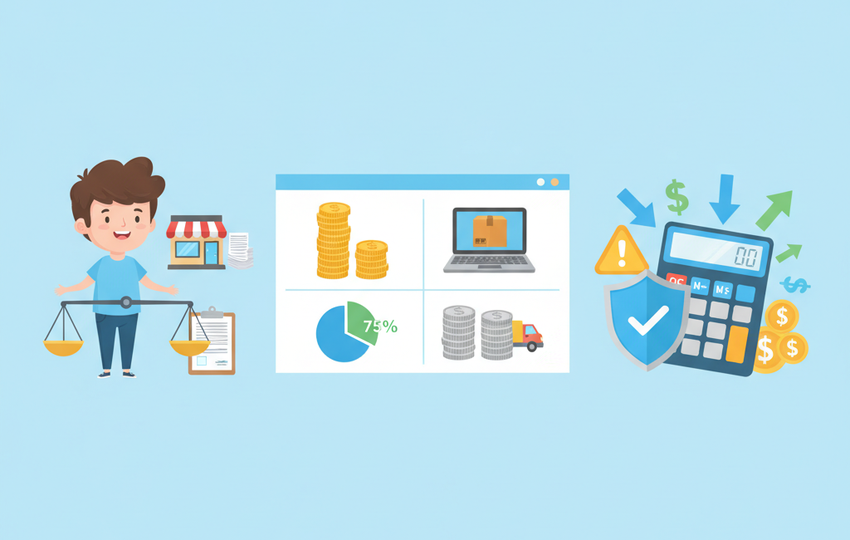
Amazon dropshipping vs dropshipping from Amazon: side by side
| Model A: sell on Amazon | Model B: source from Amazon, sell on eBay | |
|---|---|---|
| Monthly plan | $39.99 Professional | $0 (eBay store optional, from $4.95/mo annual Starter) |
| Per-sale fees | Referral 8 to 15 percent (+ $1.80 media closing fee) | 13.6 percent + $0.40 per order in most categories |
| Approval needed | Category and brand gating, identity verification, wholesale invoices on request | Selling limits (typically 10 items / $500 for new accounts, raise by request) |
| Policy status | Allowed with a compliant supplier; retail arbitrage banned | Wholesale supplier allowed; retailer-to-buyer shipping not allowed |
| Account risk | High: Section 3 deactivation, invoice requests, funds held | Medium: case-driven, defect rate and INR enforcement |
| Typical margin | 10 to 20 percent with a real wholesaler | 15 to 30 percent, eroded by Amazon price changes |
| Shipping speed | Set by your supplier | Prime, 1 to 3 days in the US |
| Tools | Inventory and repricing software, invoice management | Listing, price and stock monitor, order sync |
If you are weighing model A against Amazon's own fulfilment network, Amazon FBA vs dropshipping covers that comparison. This post stays on the two dropshipping models.
What goes wrong with amazon dropshipping?
Both models fail in predictable ways. Knowing the failure modes is most of the defence.
Amazon account deactivation (model A)
The trigger is almost always a buyer complaint or a routine invoice request. Amazon asks for invoices from the last 365 days showing at least 10 units from a supplier. A retail order history does not count. Without wholesale paperwork the appeal loops, and funds stay on hold for 90 days or more. If you sell on Amazon, only dropship from suppliers who will put your name on the packing slip and issue proper invoices.
Item Not Received and Not As Described cases (model B)
eBay's Money Back Guarantee lets a buyer open an Item Not Received case the day after the estimated delivery date. If you have not uploaded tracking from Amazon, you lose automatically and the case counts as a defect. Two or three of those on a new account crosses eBay's "Below Standard" threshold (defect rate above 2 percent, or cases closed without seller resolution above 0.3 percent), which raises your fees and restricts your listings.
Not As Described cases come from Amazon shipping a different variant, a damaged box, or the product page changing after you listed it.
Amazon packaging and gift receipts
An eBay buyer who opens an Amazon box with a gift receipt showing $28 when they paid $44.99 will either leave a negative, open a case, or report the listing. Sellers reduce this by never selecting "this is a gift," using Amazon Business accounts where slips show less pricing, and choosing items that ship in the manufacturer's box.
Price and stock changes
Amazon repricing is constant. A $28 item becomes $36 overnight, and your $44.99 listing now makes $2.47. Worse, the item goes out of stock and you are selling something you cannot buy. A manual seller with 300 listings cannot check this daily. Automated monitoring is the difference between a hobby and a business here.
Sales tax and the 1099-K
Both models produce a 1099-K once you pass the IRS reporting threshold. For 2026 payments the federal threshold is back at $20,000 and 200 transactions after the One Big Beautiful Bill Act reversed the phased $600 rule, but several states report at lower levels. Track cost of goods (your Amazon receipts) from day one or you will pay tax on gross sales.
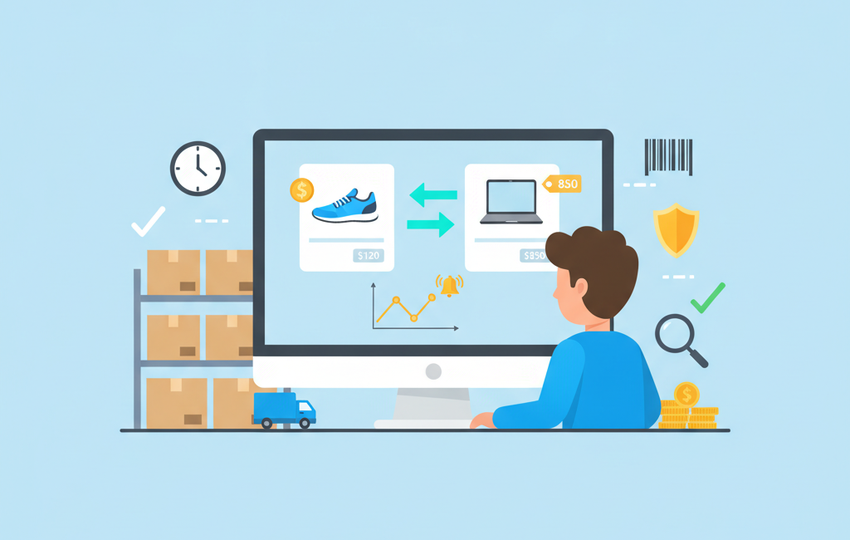
How to do amazon dropshipping safely on eBay
If you pick model B, treat every rule above as a process problem, not a luck problem.
- Source from Amazon with the right settings - buy with a dedicated Amazon account (Business if you can), never gift-wrap, never gift receipt, and skip items where Amazon is not the seller of record, since third-party Amazon sellers ship slower and in more random packaging.
- List with your own content - do not copy Amazon titles and images word for word. eBay's Cassini search rewards unique titles and complete item specifics, and Amazon-identical listings are the easiest to flag. SuperDS's Amazon to eBay lister pulls the product data and lets you rewrite the title and pick images before publishing, and the non-API lister publishes through your own eBay session rather than a third-party API app, which keeps the listing looking like you built it by hand.
- Monitor price and stock every few hours - the Price and Stock Monitor rechecks the Amazon source and raises your eBay price or ends the listing when the source moves. This one feature prevents most negative-margin sales and most Item Not Received cases from out-of-stock orders.
- Upload tracking the same day - order sync copies the Amazon tracking number to the eBay order automatically. Tracking on file is your only defence in an INR case.
- Set handling time honestly - 1 to 2 business days handling plus Prime delivery keeps your late shipment rate at or below the 3 percent Top Rated Seller limit.
- Answer cases within 24 hours - refund fast on genuine problems. A refund costs you the margin; an unresolved case costs you the account.
For the full step-by-step build, the Amazon to eBay dropshipping guide goes deeper on product research and listing structure.
Amazon dropshipping checklist
- Decide which model you are running. Selling on Amazon needs a wholesaler and invoices. Sourcing from Amazon needs an eBay account and a monitoring tool.
- Read the Amazon Drop Shipping Policy or eBay's Dropshipping Policy for your model. Know the exact sentence that applies to you.
- Never ship retailer-to-buyer on Amazon. It is a Section 3 deactivation.
- On eBay, keep defects under 2 percent and late shipments at 3 percent or less.
- Rewrite titles, pick your own images, fill item specifics.
- Turn on price and stock monitoring before you pass 50 listings.
- Upload tracking automatically, refund fast, and keep every Amazon receipt for tax time.